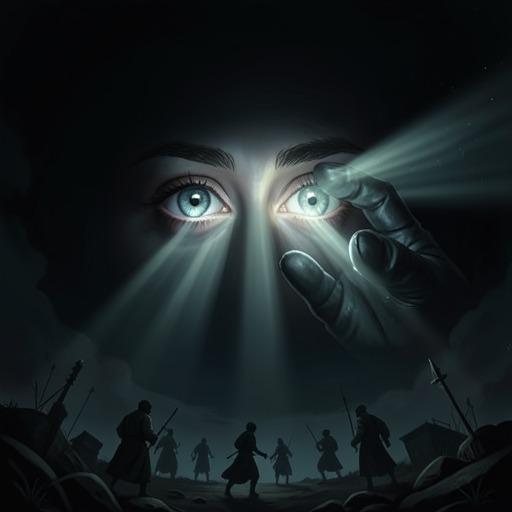
Diana and Actaeon
Metamorphoses (Ovid Edition)Diana and Actaeon forms one of the most abrupt and severe relations in the poem: a hunter’s accidental encounter with a goddess becomes a collision between mortal sight and divine privacy, ending not in explanation or reconciliation but in the annihilation of the witness. Actaeon does not deliberately seek Diana’s hidden retreat; nevertheless, his entrance into it and his sight of her uncovered body trigger a punishment that removes his human form, his speech, and finally his life.
The Secluded Grove and the Accidental Encounter
Diana’s domain is presented as a secluded vale covered with pine and cypress, cooled by gentle winds and darkened by shade. Within it stands the goddess’s private haunt, a cool grotto where she and the water nymphs can withdraw from the world of the hunt. The setting establishes separation as the foundation of the relation: Actaeon belongs to the open, noisy landscape of pursuit, while Diana’s bathing place is protected by enclosure, shade, and distance.
Actaeon reaches the grotto after the hunters have returned from the sultry plain, carrying the animals killed in the chase. The evidence does not make him a deliberate aggressor toward Diana; it describes him as a young hunter bewildered in the wood and led to the cool grotto by hard fate. His trespass is therefore accidental in intention but decisive in consequence. The relation begins through an asymmetry of knowledge: Diana and her nymphs possess a private space, while Actaeon suddenly becomes the uninvited bearer of forbidden knowledge.
Diana’s Exposure and Immediate Response
Diana is standing undressed when Actaeon appears. The nymphs crowd around her body in an effort to conceal it, while some draw back and look toward him from the side. The scene makes the goddess’s vulnerability visible without diminishing her authority. For a moment Diana would have seized her bow, the weapon associated with her sovereignty as a chaste huntress, but the surrounding water prevents her from doing so.
Her response instead uses the water itself as an instrument of judgment. She gathers water in the hollow of her hand and throws it into Actaeon’s face, accompanying the act with a challenge that calls attention to the extraordinary sight he has witnessed: a goddess exposed naked to mortal view. The gesture is both physical and verbal. The water touches Actaeon’s body, while Diana’s words define his vision as an offense whose consequence will be imposed immediately.
Metamorphosis and Loss of Human Agency
After Diana’s water strikes him, Actaeon begins to disappear by slow degrees and ends as a deer. The transformation proceeds through visible bodily changes: antlers rise from his brow, and his human identity is replaced by the shape of the hunted animal. His punishment is not merely an alteration of appearance. It converts the hunter into prey and places him inside the very order of pursuit that had previously given him mastery.
The metamorphosis also destroys the possibility of defense. Actaeon is left to ponder his shame and fear, but his changed body cannot communicate what happened. His first crisis is inward: shame and fear assail his aching heart by turns. His second is external and immediate: he sees his opening hounds behind him and hears their cries. The dogs recognize neither their master’s altered identity nor the injustice of the chase; the transformed Actaeon can only flee.
The pack closes around him. The fleetest hounds press at his heels and spring before the rest, and another pair fastens upon him. He runs from shouting men, horns, and dogs, deafened and stunned by their confused cries, but the sound that once celebrated his authority as a hunter now becomes the machinery of his destruction. The relation reaches its final reversal when Actaeon is pursued by the companions and animals that formerly obeyed him.
Reversal, Punishment, and Narrative Meaning
The episode is structured around a sharp reversal of roles. Diana is the huntress, yet in the grotto she is momentarily deprived of her bow and forced to defend privacy with water. Actaeon is the hunter, yet a single encounter turns him into quarry. The same landscape that once enabled his triumph becomes the setting of his helpless flight, and the same hounds that made his reputation complete the punishment begun by Diana.
The relation is therefore governed by the power of divine speech and gesture rather than by mutual understanding. Elsewhere in the poem, a prayer may appeal to a power’s pity, and a pledge sworn by a god may bind the speaker to fulfill a request; here, however, Actaeon has no opportunity to plead. Thetis is invoked elsewhere as a righteous power whose pity may be moved by human misery, but Diana’s scene emphasizes the opposite possibility: divine authority can answer human suffering only after judgment has already taken effect. Actaeon’s transformation leaves no stable interval in which explanation could alter the outcome.
The episode also exposes the instability of sight. Actaeon’s gaze is accidental, but the poem treats seeing the goddess in a forbidden condition as an event with material force. What he sees cannot remain a private perception; Diana’s response turns vision into bodily alteration, and bodily alteration into public pursuit. The witness is erased so that the violated privacy can no longer be narrated by the person who saw it.
Ending and Lasting Significance
Actaeon’s ending is especially cruel because his destruction is carried out by the instruments of his former identity. He is not simply killed by a divine weapon or removed from the world through an invisible curse. His own hounds, awakened by the hunt’s customary cries, pursue the deer before them; the men and horns around him intensify the confusion. The punishment makes recognition impossible at the very moment when recognition would save him.
Diana and Actaeon thus represents metamorphosis as social as well as physical erasure. Actaeon loses his human shape, his power to speak, his authority over the hunt, and his place among his companions. Diana remains the source of the transformation, but the episode’s final image belongs to the reversed hunt: the master becomes the animal, the witnesses become pursuers, and the private encounter ends in a public death. Its decisive significance lies in that irreversible chain, by which accidental presence becomes offense, sight becomes exposure, exposure becomes transformation, and transformation makes the victim unable to prove who he was.